
I recognized the flyer before I even finished scrolling past it. The layout, the colors, the illustration style: it was mine. Or it had been. A branding flyer I’d designed for a ministry the year before was now dressed up with a few new AI-generated elements bolted onto the same bones I’d built.
Nobody called me and nobody asked. My client didn’t need me this time. They only needed a few minutes and a prompt.
I sat with that for a while because it raised a question I’d been asking myself: was this about speed, or was my perceived value quietly eroding while I wasn’t looking? Either answer stung, but the second one sent my thoughts swirling.
Here’s what gets lost in most conversations about AI and design: I’ve never called myself just a graphic designer. When it comes down to it, I’m a brand manager. My job was never to design pretty flyers; it was to protect brand fidelity across every touchpoint, so that a small business or ministry with the least money and the least time still looked, sounded, and felt consistent. AI didn’t replace a flyer; it replaced what held the flyer together.
Brand Management vs. AI
-
-
-
- A brand is more than a single design; it’s a consistent identity carried across every piece of communication.
- AI can reproduce a look in minutes, but it doesn’t know the reasoning behind a brand’s choices.
- Skipping the person who manages the brand is a different problem than needing speed.
-
-
I’ve watched churches, ministries, and small businesses operate on almost no runway for years. A pastor announces an event on a Tuesday and needs promotional material by Thursday. Let’s face it, CEOs wear a million hats and don’t have time to plan events months ahead. If AI is filling that gap, I get it. I’ve leaned on shortcuts myself.
But speed doesn’t fully explain what I saw. The client didn’t need something from scratch in a pinch. It felt like they chose convenience over relationship. My work was sitting right there, and the faster option wasn’t calling me; it was skipping me entirely. That’s a different problem than urgency. That’s a decision, conscious or not, that a conversation with me had become optional.
So I’ve had to ask myself the less comfortable question: is my value shrinking because AI can now do in five minutes what used to take me an afternoon? I don’t think the honest answer is a simple yes or no. Some of what I do can be replicated quickly, and pretending otherwise doesn’t serve myself or my clients well. However, much of what I do was never about the minutes it took. It was about knowing why the ministry’s color palette skews warm rather than cold, why the typography needs to feel approachable rather than corporate, and why a summer event flyer needs a different energy than a conference flyer. AI can mimic the output, but it has no idea why any of it was chosen in the first place.
That’s the part that doesn’t show up when you’re just comparing five minutes to five hours.
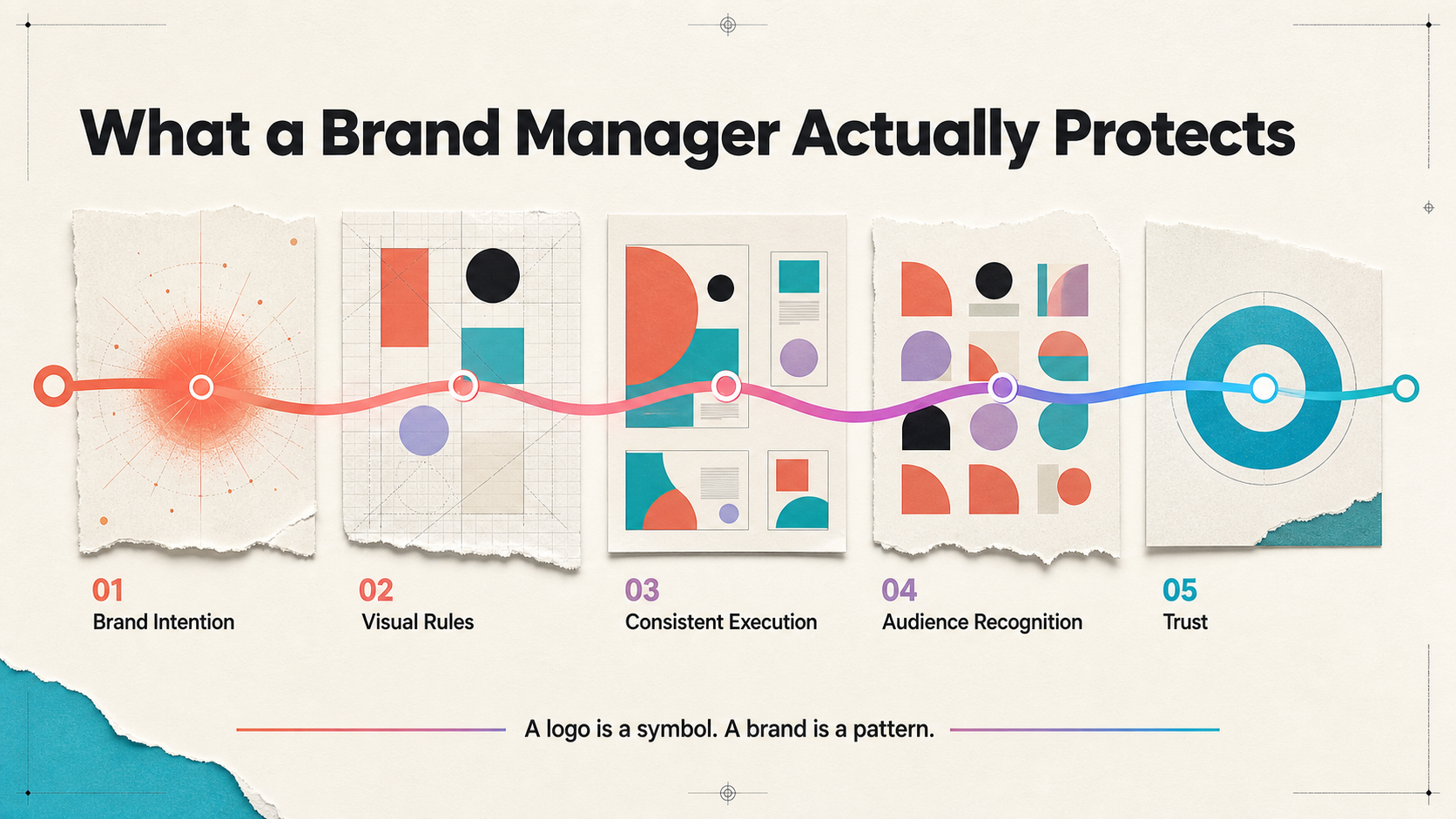
People hear “brand manager” and think it’s a fancier title for “person who picks the logo colors.” It isn’t. A logo is a symbol; a brand is a pattern, and patterns only work if someone protects them.
For the ministries and small businesses I work with, that pattern is what makes a flyer, a sermon series graphic, and a social post all feel like they came from the same place, even if a visitor never consciously notices why. It’s the difference between an organization that looks like it knows who it is and one that looks like it’s improvising every few months. Consistency builds trust before a single word is read. People recognize a familiar look the way they recognize a familiar voice, and for organizations trying to grow community or customer loyalty, that recognition matters more than any single design ever will.
That’s the layer AI skips. It doesn’t know that this ministry’s brand leans warm and handwritten because the pastor wanted the visuals to feel like an invitation and not an advertisement, or that a small business’s brand runs bold and no-nonsense because the owner built it on being the reliable option in town. It doesn’t know that a certain shade of blue got retired two years ago because it clashed with the building’s new signage. It doesn’t know the history behind any of it because it was never in the room when the decisions that built the brand were made in the first place. It can copy a look, but AI can’t carry the intention forward.
That’s the job. Not making things look nice one flyer at a time, but making sure a hundred small decisions, made by different people, under different deadlines, over several years, still add up to one coherent identity. Speed doesn’t threaten that job. Skipping the person who holds it does.
Brand Management vs. AI Design
-
-
-
- A brand manager’s job is protecting the pattern behind the design, not just producing individual pieces.
- Brand consistency builds trust and recognition before a single word is read.
- AI can copy a visual style, but it cannot carry forward the reasoning and history behind it.
-
-
Here’s what makes this especially costly in ministry and small business work: these aren’t organizations with room to recover from a diluted identity. Most ministries and small businesses survive on trust, word of mouth, and the sense that this is a place worth showing up to again. They don’t have marketing budgets to buy back credibility if the visuals stop feeling like them. A large, well-funded brand can absorb an off-brand campaign and course-correct next quarter. A church or small business whose flyer looks like it could belong to any organization loses something quieter and harder to measure: the feeling that this event, this ministry, this business, is specific and known.
I think about the irony of it constantly. It took real effort to get some of these clients to plan thirty days out instead of three. That lead time wasn’t just about my schedule. It gave the brand room to breathe: time to make sure a graphic actually matched the season the ministry or business was in, time to catch a message that wasn’t landing before it went out to the whole congregation or customer base. Then AI shows up and collapses that entire conversation into a five-minute prompt. The lead time didn’t disappear. It just stopped mattering, because the thing it protected isn’t seen as necessary anymore.
What gets lost isn’t polish. Ministries and small businesses were never chasing polish. What gets lost is specificity, the sense that this flyer, this graphic, this event, could only have come from this particular community or business. Replace that with something generic enough to have come from anywhere, and you haven’t saved time. You’ve quietly traded away the one thing a small ministry or business actually has going for it: originality.
None of this means I think AI has no place in this work. I use it myself to create images and churn out quick flyers when the timeline demands it. But I’ve learned to construct prompts carefully, feeding it enough of my own style and brand history that what comes back actually feels like the brand rather than someone else’s. And I don’t stop there. I still bring it into Adobe Creative Cloud to add the consistent elements, the spacing, the typography treatment, the small details that keep it tethered to everything else that business has ever put out. AI gets me a head start. It doesn’t get the final say.
The line I draw isn’t AI versus no AI, it’s collaboration versus substitution. Collaboration looks like what I just described: a designer feeding AI enough context to move faster, then still finishing the job with the judgment AI doesn’t have. Substitution looks like skipping that person entirely and hoping the brand holds itself together. It won’t. Patterns don’t maintain themselves. Someone has to keep deciding, event after event, why this and not that.
So if you’re a ministry, or any small organization leaning on AI because the budget or the timeline demands it, I’d only ask this: before you let AI touch something with your name on it, make sure someone still knows why your brand looks the way it does. If that person is a designer you already trust, loop them in, even briefly. It costs less than you think, and it’s cheaper than slowly becoming a brand nobody recognizes.
And if you’re a designer reading this, wondering if your value is shrinking the way I did, stop torturing yourself. I think it’s harder to see now, because the fast, visible parts of the job got automated first. What’s left is the part that was always the actual job: guarding the why. That part isn’t going anywhere, as long as we keep insisting it matters.
Why Using AI As A Collaborative Tool Matters
-
-
-
- AI works best as a collaborator that speeds up the mechanical parts of design, not as a replacement for brand judgment.
- Small organizations with limited budgets have the most to lose from a diluted brand identity, since they can’t easily buy back credibility.
- Before using AI on brand materials, involve the person who understands why the brand looks and sounds the way it does.
-
-